
Conditions we treat
Hyperpigmentation
Brightening, pigment-correcting care for every skin tone. Our protocols work on excess melanin at each layer, to bring back a clear, even complexion.
Conditions We Treat
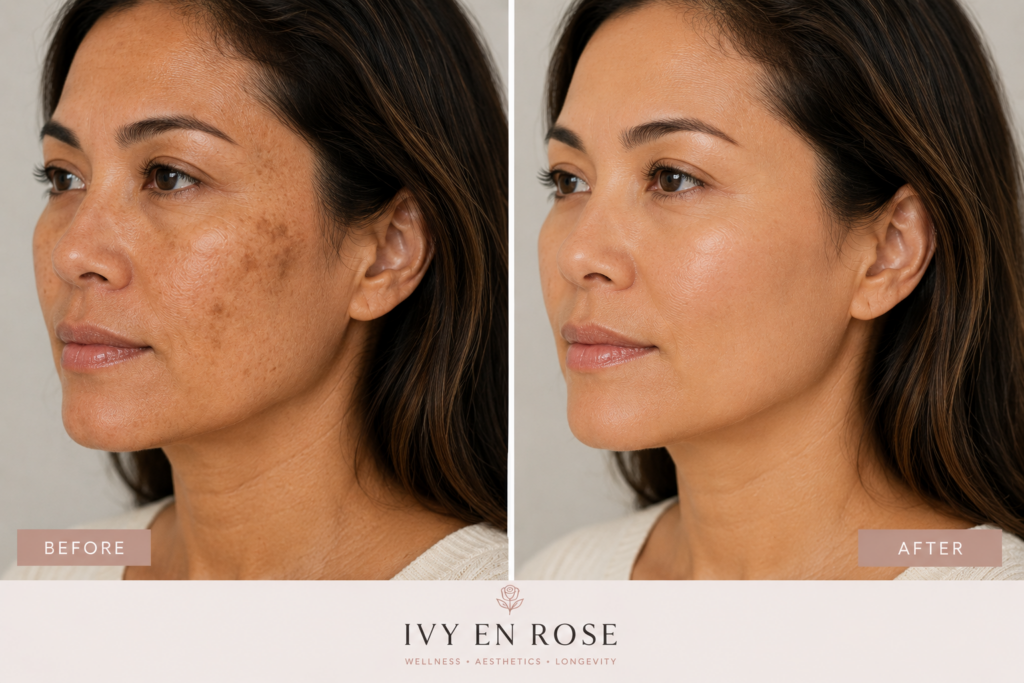
Before & After: Hyperpigmentation Protocol
What is Hyperpigmentation?
Hyperpigmentation is a common condition in which patches of skin turn darker than the areas around them. The darkening happens when too much melanin (the brown pigment behind your skin's natural colour) forms deposits down in the deeper layers. It shows up in every skin type and can appear anywhere on the body, though the face, hands, and chest are the usual sites.
Main Types of Hyperpigmentation
Sun Spots (Solar Lentigines)
Sometimes called age spots or liver spots. These flat brown spots come from years of accumulated UV exposure, and they tend to surface where the sun reaches most: the face, hands, and arms.
Melasma
Usually set off by hormonal change, melasma produces larger, symmetrical patches, most often across the cheeks, forehead, nose, and upper lip. It appears frequently in pregnancy (hence the old name 'mask of pregnancy') and while taking birth control pills.
Post-Inflammatory Hyperpigmentation (PIH)
PIH follows an injury or inflammation: a breakout, eczema, a burn, or a cosmetic treatment that was too harsh. After the original wound heals, a flat pink, red, or dark brown mark stays behind.
Primary Causes and Triggers
UV Radiation
Sunlight is the leading cause. UV rays prompt your melanocytes, the cells that make pigment, to produce extra melanin as a defence, protecting the skin from burning.
Hormonal Fluctuations
Estrogen and progesterone can drive melanin overproduction, even when the skin sees only small amounts of sunlight.
Skin Inflammation
Any trauma releases inflammatory chemicals that signal the melanocytes to make additional pigment while the skin heals.
Aging
With age the number of pigment-producing cells falls, but the ones that remain grow larger and cluster in particular areas.
Common Prevention and At-Home Management
Strict Sun Protection
A broad-spectrum sunscreen at SPF 30 or higher, worn daily, is the single most important step. Without it, fading treatments will not work.
Vitamin C
A strong antioxidant that blocks the enzyme responsible for making melanin, which helps brighten the dark spots you have and prevents new ones forming.
Retinoids
Retinol and tretinoin accelerate cell turnover, so heavily pigmented cells shed sooner and lighter ones move up to replace them.
Tyrosinase Inhibitors
Kojic acid, azelaic acid, tranexamic acid, and alpha arbutin all help interrupt the chemical pathways that produce excess pigment.
Is the darkening showing up as small scattered sun spots, as larger symmetrical patches across your face (melasma), or as marks left behind by old breakouts (PIH)? Identifying the type helps us narrow down the right advice. Come and see us at Ivy en Rose.
What are the issues with Hyperpigmentation?
Medically speaking hyperpigmentation is usually harmless, but it brings real difficulties for skin health, for cosmetic coverage, and for how you feel.
Uneven Complexion and Dullness
Loss of Natural Glow
Scattered dark patches change the way light bounces off the face. Rather than an even brightness, the skin can read as muddy, tired, and flat.
Premature Aging Look
Clusters of sun spots and melasma are strongly linked with advanced skin ageing, and often make a person look older than they are.
Cosmetic and Coverage Frustrations
Difficult to Camouflage
Dark spots, severe melasma and deep post-inflammatory marks especially, are remarkably stubborn to hide. Ordinary foundation frequently fails to cover them, which means reaching for heavy colour-correcting concealers that can end up looking cakey.
Ashy or Gray Undertones
Applying makeup straight over hyperpigmentation without a colour corrector underneath lets the dark spots bleed through, so the finish turns muddy or grey.
Resistance to Treatment and Extended Healing
Deep Dermal Staining
Once excess melanin sinks into the lower layer of skin (the dermis) it becomes very hard to treat. Fading spots at that depth can take many months, or years, of steady effort.
High Risk of Recurrence
Pigment-producing cells hold a kind of 'memory'. Even after a dark spot has been faded successfully, a few minutes of unprotected sun or heat can reactivate those cells, and the patches return almost overnight.
Sensitivity to Treatments
Plenty of effective fading ingredients, such as high-strength retinoids and chemical peels, can irritate. If the skin gets too irritated, that triggers fresh inflammation, which sets off a cycle producing yet more dark marks.
Psychosocial and Emotional Impact
Self-Consciousness
Living with noticeable patches on your face can knock self-esteem considerably, and many people become uncomfortable leaving the house without makeup.
Frustration and Treatment Fatigue
Fading pigment demands real patience, firm lifestyle adjustments, and sunscreen without fail, so it is common to feel deeply frustrated while waiting for results to show.
Are you dealing with dark marks left by acne, or working to manage broader patches such as melasma? Telling us which helps us narrow down the most effective way to treat it. Come and talk it through with us at Ivy en Rose.
How Ivy en Rose Treats Hyperpigmentation
We approach hyperpigmentation, sun damage, and melasma in layers. Our protocols bring together advanced light-based energy treatments, cellular regeneration therapies, and internal skin-brightening infusions, to clear melanin deposits sitting deep in the skin.
Advanced Light & Energy Modalities
IPL (Intense Pulsed Light) Photofacials
This is one of our core services for fading dark spots and evening out overall tone. The device sends out targeted light wavelengths that excess melanin absorbs, which breaks up sun spots and age spots so they can flake away naturally.
Morpheus8 RF Microneedling
Where stubborn texture comes paired with discolouration, Morpheus8 prompts deep dermal remodelling. We give careful pre-treatment guidance (pausing active retinoids, avoiding UV strictly) to prepare the skin safely and help prevent post-inflammatory hyperpigmentation (PIH) as cells renew.
Internal Skin-Brightening Infusions
Glutathione IV Therapy
We make heavy use of Glutathione IV infusions as an internal approach to hyperpigmentation. Glutathione acts as a master antioxidant that blocks the production of dark melanin and deactivates the tyrosinase enzyme, for an even, whole-body brightening effect.
Regenerative Upgrades & Topical Support
PRP (Platelet-Rich Plasma) & Exosomes
These cellular therapies can be layered over microneedling treatments, as they are in our Silver and Platinum Packages. Concentrated growth factors accelerate the skin's healing response, help regulate uneven pigment production, and encourage damaged, darkened cells to shed faster.
Medical-Grade Clinical Products
Through our in-clinic apothecary and physician-guided regimens, we supply targeted topical treatments: specialised brighteners, plus the protective broad-spectrum mineral sunscreens needed to shield healing skin and keep hyperpigmentation from coming back.
Are you mainly hoping to clear scattered sun spots and age spots, or managing something more chronic such as hormonal melasma? Knowing which helps us map the most effective sequence of treatments for your goals. Let's talk it through at Ivy en Rose.
Personalized pigment-correcting protocol
Book a consultation and our medical team will design a plan that combines in-clinic procedures with medical-grade homecare, to restore an even, luminous tone.