
News
Botox Safety, FDA Guidelines, Long-Term Results, and How to Choose the Right Provider in San Francisco
Aesthetics
Botox is now among the most widely chosen non-surgical cosmetic treatments anywhere, and the reasons are easy to see. In the hands of qualified medical professionals it can soften dynamic facial wrinkles, refresh how you look, and leave natural facial movement intact, with very little downtime.
Even so, patients usually arrive with real questions before they begin.
Is Botox safe?
What are the long-term risks?
Will I still look like myself?
How do I know I'm choosing the right provider?
Those answers matter. Botox itself has been studied extensively, but the quality of any given result rests on the provider's expertise, on choosing the right patient, and on injection technique.
This guide walks through what the current medical evidence says about Botox safety, its FDA-approved uses, and long-term outcomes, and why physician-led care matters so much in reaching beautiful, natural results.
Botox Cosmetic (onabotulinumtoxinA) is an FDA-approved prescription medication made from purified botulinum toxin type A. Injected into carefully chosen facial muscles, it temporarily reduces the muscle activity behind dynamic wrinkles.
Dynamic wrinkles differ from those driven mainly by sun damage or collagen loss: they build up through repeated facial expression across many years. Relaxing those muscles temporarily lets the skin above look smoother, and at an appropriate dose the face still expresses itself naturally.
Treatment usually takes just 10–15 minutes with little or no downtime, which makes it one of the more convenient cosmetic procedures available.
In the United States, Botox Cosmetic carries FDA approval to temporarily improve the appearance of:
- Forehead lines, moderate to severe
- Glabellar lines: the vertical "11 lines" sitting between the eyebrows
- Crow's feet at the eyes
Those approvals rested on large clinical trials, which showed significant improvement against placebo while maintaining an acceptable safety profile when the medication is given according to FDA-approved guidelines.
Experienced physicians may also use Botox for other aesthetic purposes, based on clinical judgment. Patients should know whether what they are being offered is an FDA-approved indication or an off-label use, and should talk through the reasoning at consultation.
Before Botox was widely available, facial rejuvenation usually meant laser resurfacing, chemical peels, dermabrasion, or surgery.
Those treatments still have real value for the right patients, but Botox brought in a minimally invasive way to reduce dynamic wrinkles without a long recovery.
Results generally start to show within a few days, keep improving for around two weeks, and commonly hold for three to four months, though individual response varies.
Whether Botox is safe is one of the questions patients ask most.
Decades of clinical research give a reassuring answer.
Few treatments in cosmetic medicine have a safety profile studied as thoroughly. Millions of cosmetic treatments have been carried out worldwide, and large clinical studies have consistently shown a favourable safety profile where injections are given by appropriately trained medical professionals at recommended doses.
That said, like any prescription medication, Botox is not entirely free of risk.
Side effects are mostly temporary and mild, though rare serious complications have been reported. Knowing both the benefits and the risks is what makes an informed decision possible.
Patients sometimes come across mentions of Botox's FDA boxed warning online, and become understandably worried.
The warning is there because botulinum toxin products have, in rare circumstances, been associated with effects reaching beyond the site of injection.
Those reports have mainly come from therapeutic uses at doses substantially higher than the ones typical of cosmetic facial treatment, though the FDA does advise every provider to stay vigilant whatever the indication.
It is one more reason that choosing the right patient, dosing conservatively, and injecting precisely all matter so much.
Patients should always talk through the potential risks with their treating medical professional before going ahead.
Side effects from cosmetic Botox are mostly temporary, and resolve without lasting trouble.
Those reported most often include:
- Bruising, usually mild
- Swelling that passes
- Tenderness at the injection site
- Headache
- Eyelid drooping (ptosis), temporarily
- Brow asymmetry, temporarily
These become less frequent as an injector's experience and treatment planning develop.
Serious adverse events are uncommon in cosmetic practice, but they have been reported.
They may include:
Trouble swallowing
Trouble speaking
Weakness in the muscles
Double vision
Trouble breathing
Some patients, those with certain neuromuscular disorders or other medical conditions, may face higher risk, and need careful evaluation before any treatment.
Anyone who notices unusual symptoms after Botox should get in touch with their healthcare provider promptly.
Patients often ask whether years of Botox does any harm.
The evidence so far is generally reassuring.
Long-term studies suggest that repeated cosmetic treatment stays well tolerated for most appropriately selected patients.
Researchers have also noticed that certain side effects may actually become less frequent across successive treatment cycles, as providers refine their injection patterns and treatment plans.
A few people may gradually develop antibodies that reduce how well the treatment works, but that appears uncommon, particularly at conservative doses given at appropriate intervals.
If one theme runs strongest through the medical literature, it is how much individualised dosing matters.
More Botox is not automatically better.
Many experts in fact recommend the lowest effective dose that will achieve the cosmetic result you want, while keeping facial movement natural.
That approach may reduce unnecessary exposure, and it tends to produce softer, more natural outcomes.
Choosing where to have Botox should involve more than comparing prices.
The evidence points consistently to a handful of qualities worth looking for:
- Licensed medical professionals who have advanced training
- A thorough grasp of facial anatomy
- A full consultation before any treatment
- A conservative approach to dosing
- Treatment planned for the individual
- Risks and benefits discussed openly
- Follow-up with the patient where appropriate
All of these shape both the safety and the cosmetic outcome.
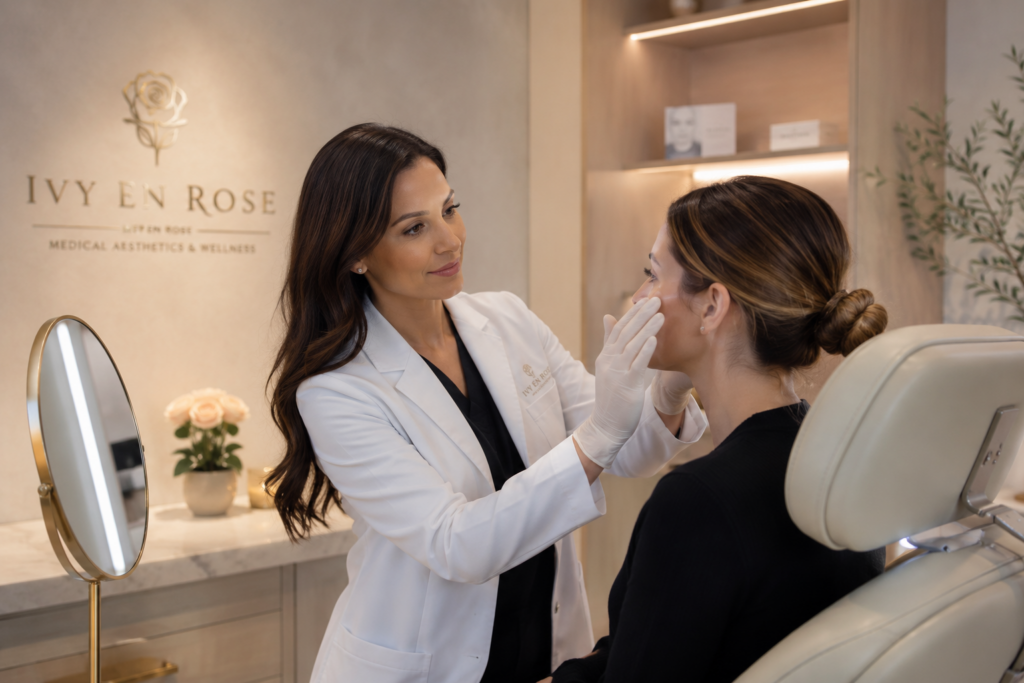
At Ivy en Rose Medical Aesthetics & Wellness, our philosophy follows the same evidence-based principles that run through the scientific literature.
Every Botox consultation opens with a thorough evaluation: your facial anatomy, how your muscles move, your medical history, your aesthetic goals, and anything that might affect the safety of treatment or its results.
We are not chasing dramatic change. The work is to enhance what is already yours, through physician-led planning and care built for you.
Our conservative philosophy means using the smallest effective dose that will give a refreshed, balanced, natural-looking result, keeping facial expression intact wherever that is appropriate.
Every face is different, so every treatment plan is too. Botox should complement your features rather than redefine them.
For many patients the most successful cosmetic treatment is the one where friends say, rather than wondering what has changed.
"You look refreshed,"
Most cosmetic Botox treatments hold their results for roughly three to four months, though individual response varies.
How long does Botox last?
Not when treatment is planned carefully and dosed conservatively. Natural-looking results depend heavily on injection technique tailored to the individual.
Will I look frozen?
Most patients describe the injections as quick, well tolerated, and needing little or no downtime.
Is Botox painful?
Botox may help reduce the repetitive muscle movement that contributes to dynamic wrinkles forming, although individual results vary.
Can Botox prevent wrinkles?
Patients with certain neuromuscular disorders, an active infection at the injection site, a known hypersensitivity to the product, or other contraindications identified during medical evaluation may not be appropriate candidates.
Who should avoid Botox?
Botox remains among the most thoroughly studied and most widely performed cosmetic procedures available. Decades of research support both its effectiveness and its favourable safety profile, where it is given by qualified medical professionals with appropriate patient selection, conservative dosing, and precise injection technique.
Choosing a provider means more than finding someone who offers Botox. It means finding a practice that values a thoughtful consultation, care built around the individual, and treatment grounded in evidence. At Ivy en Rose Medical Aesthetics & Wellness, those principles guide every Botox treatment we give, with the aim of helping patients look refreshed, confident, and authentically themselves.